System Architecture
Overview
Uniconnect AI is a layered platform that brings voice, messaging, CRM, automation, and AI together on one foundation, built to scale from the first deployment onward.
The platform is service-oriented and event-driven, so each capability works as part of the whole and reacts to business activity as it happens. It can be deployed on-premise, in the cloud, or as a hybrid, and security is applied across every layer. This page gives a high-level view of how the platform is organized.
Architecture at a Glance
Each layer builds on the one below it. Activity flows down from the people and systems using the platform to the data and infrastructure underneath, while security and compliance apply to every layer, as shown in the diagram below.
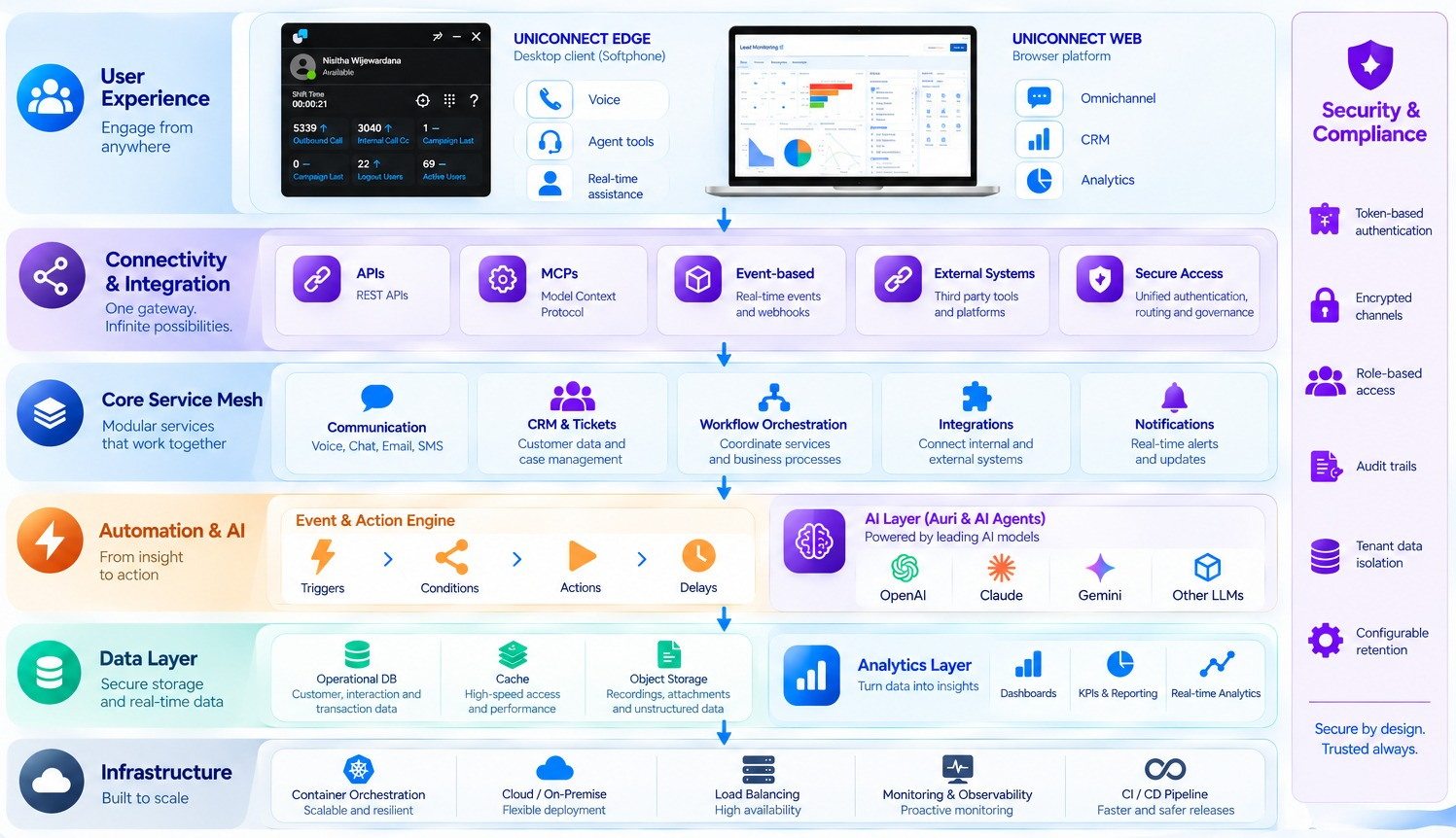
Figure 1. The Uniconnect AI layered architecture, from User Experience at the top to Infrastructure at the bottom, with Security and Compliance applied across every layer.
Design Principles
- Service-oriented: Modular services that work together, so capabilities can be added and scaled independently.
- Event-driven: Services respond to events in real time, which keeps conversations, records, and automations in step.
- Deploy anywhere: On-premise, cloud, or hybrid, to match an organization's infrastructure and compliance needs.
- Secure by design: Security and compliance are applied across every layer rather than added on top.
Platform Layers
| Layer | Role | Includes |
|---|---|---|
| User Experience | How agents, supervisors, and administrators work with the platform. | Uniconnect Edge, Uniconnect Web |
| Connectivity & Integration | A single, governed way in and out of the platform for other systems. | APIs (REST), MCPs (Model Context Protocol), event-based integration, external systems, secure access |
| Core Service Mesh | The business services that run day-to-day operations. | Communication, CRM & Tickets, workflow orchestration, integrations, notifications |
| Automation & AI | Turns events into actions, and brings AI into conversations and daily work. | Event & Action Engine, AI Layer (Auri Copilot and AI Agents) |
| Data & Analytics | Keeps the platform's data and turns it into insight. | Data layer (operational database, cache, object storage), analytics layer (dashboards, KPIs and reporting, real-time analytics) |
| Infrastructure | The scalable, resilient foundation the platform runs on. | Container orchestration, cloud or on-premise deployment, load balancing, monitoring and observability, CI/CD pipeline |
User Experience
People work with Uniconnect AI through two clients that share the same platform and data.
- Uniconnect Edge: A desktop client (softphone) for voice, agent tools, and real-time assistance.
- Uniconnect Web: A browser platform for omnichannel conversations, CRM, and analytics.
Connectivity & Integration
Systems outside the platform connect through one gateway, with unified authentication, routing, and governance. REST APIs, MCPs (Model Context Protocol), real-time events and webhooks, and third-party tools and platforms all follow the same controlled route.
Core Service Mesh
The core services cover communication across voice, chat, email, and SMS, customer data and case management in CRM, workflow orchestration, integrations, and real-time notifications. They are modular, so they evolve independently while working together as one platform.
Automation & AI
The Event & Action Engine turns activity into action. Rules are built from triggers, conditions, actions, and delays, so the platform can respond automatically to what happens in the business.
AI is built into the platform and powered by leading AI models, including OpenAI, Claude, and Gemini, as well as other LLMs. Auri Copilot is the internal assistant that helps staff. AI Agents are separately configurable, customer-facing agents. The two serve different audiences and are configured independently.
Data & Analytics
The data layer provides secure storage and real-time data. It holds customer, interaction, and transaction data in an operational database, uses a high-speed cache for performance, and keeps recordings, attachments, and other unstructured data in object storage. The analytics layer turns that data into dashboards, KPIs and reporting, and real-time analytics.
Infrastructure
The platform is built to scale. Container orchestration keeps it scalable and resilient, cloud and on-premise options give flexible deployment, load balancing provides high availability, monitoring and observability keep the platform under proactive watch, and a CI/CD pipeline supports faster, safer releases. See Deployment Options.
Example Data Flow
The steps below show how the layers work together when a customer contacts an organization.
- The customer reaches the organization by voice, chat, email, or SMS, and the interaction enters the platform through its connectivity layer.
- Core services record the interaction against the customer in CRM and route it to the right agent or AI Agent.
- The Event & Action Engine applies the organization's rules, such as notifications, follow-ups, or escalations.
- An agent, supported by Auri Copilot, or an AI Agent handles the conversation from Uniconnect Edge or Uniconnect Web.
- Interaction data is stored securely and feeds dashboards and reports in real time.
Deployment Options
- On-premise: Run the platform in the organization's own environment, keeping infrastructure and data under its direct control.
- Cloud: Run the platform in the cloud for fast setup and flexible scaling.
- Hybrid: Combine on-premise and cloud to match the organization's operational and compliance needs.
Security & Compliance
Security is built into every layer of the platform rather than added afterward.
- Token-based authentication: users and connected systems are authenticated with tokens.
- Encrypted channels: communication between clients and the platform travels over encrypted channels.
- Role-based access: people see and do only what their role allows.
- Audit trails: activity is recorded so it can be reviewed.
- Tenant data isolation: each tenant's data is kept separate from others.
- Configurable retention: organizations control how long their data is kept.